

16 Feb 3 Tips for the Selective School Test and OC Test
It’s a really competitive world out there when it comes to successfully sitting the entrance exams for Selective Schools and Opportunity classes. While it’s no secret that preparation is key, consistency is important, but a love of learning is the necessary link to achieve those academic goals.
It’s a highly competitive world out there when it comes to successfully sitting the entrance exams for NSW Selective High Schools and Opportunity Classes. While it’s no secret that preparation and consistency are key, a love of learning is the ultimate link to achieving those academic goals.
In 2026, the NSW Department of Education has implemented major structural shifts. Crucially, the exams are now fully computer-based, and all tests must be sat physically at designated test centres within NSW.
What are the OC and Selective School Tests?
This is a computer-based placement test for Year 4 students entering Year 5 the following year. The test is used to identify an academically gifted and high-potential students. Students are then offered a place in an opportunity class for Year 5 and 6 in public primary schools in NSW.
Format: fully digital, and computers are provided at the test centres.
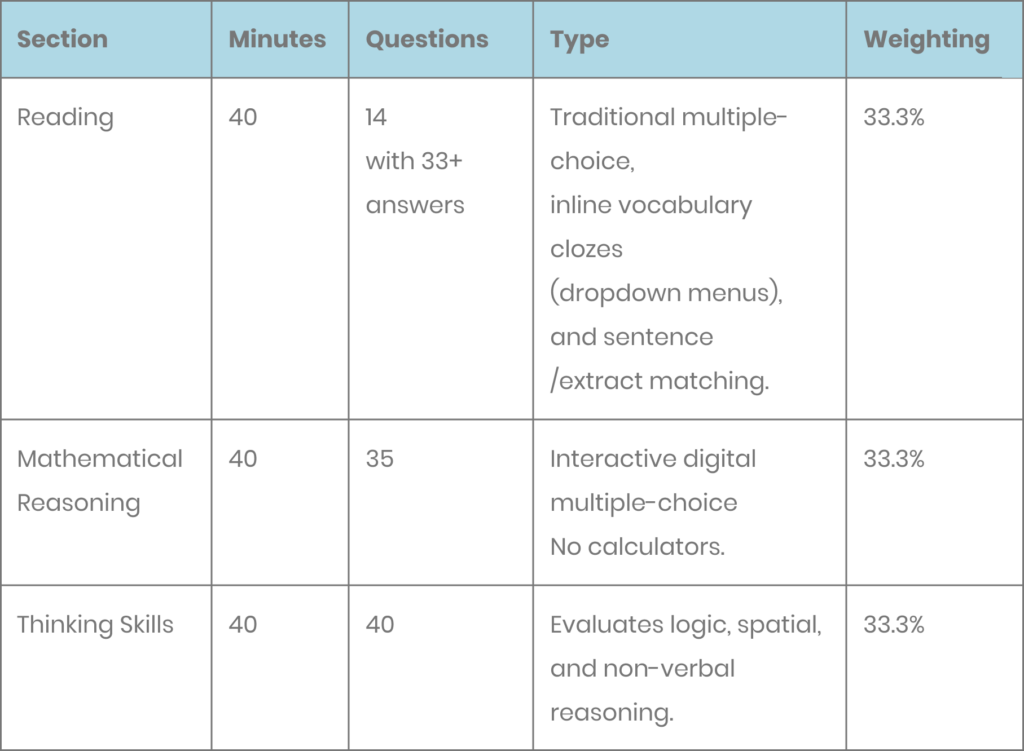
The OC Test is made up of 3 equally weighted components (33.3% each), completely modernised for the digital platform:
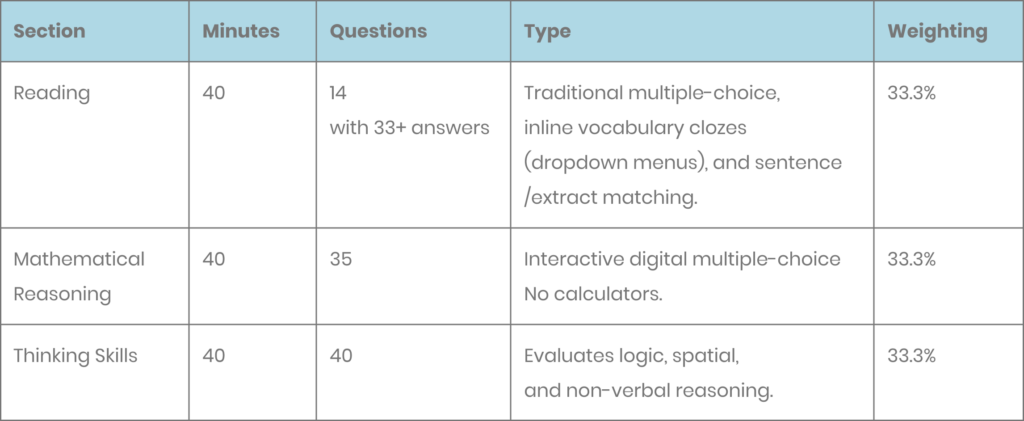
| Section | Minutes | Questions | Type | Weighting |
|---|---|---|---|---|
| Reading | 40 | 14 with 33+ answers |
Traditional multiple-choice, inline vocabulary clozes (dropdown menus), and sentence /extract matching. |
33.3% |
| Mathematical Reasoning |
40 | 35 | Interactive digital multiple-choice No calculators. |
33.3% |
| Thinking Skills | 40 | 40 | Evaluates logic, spatial, and non-verbal reasoning. |
33.3% |
This is a placement test for Year 6 students entering Year 7 the following year. In 2026, the test will be held in May. However, the exam is held every year, so students in Years 8-11 can also sit the placement test to try to gain entry into a selective school.
Format: fully digital, sat on department-provided computers
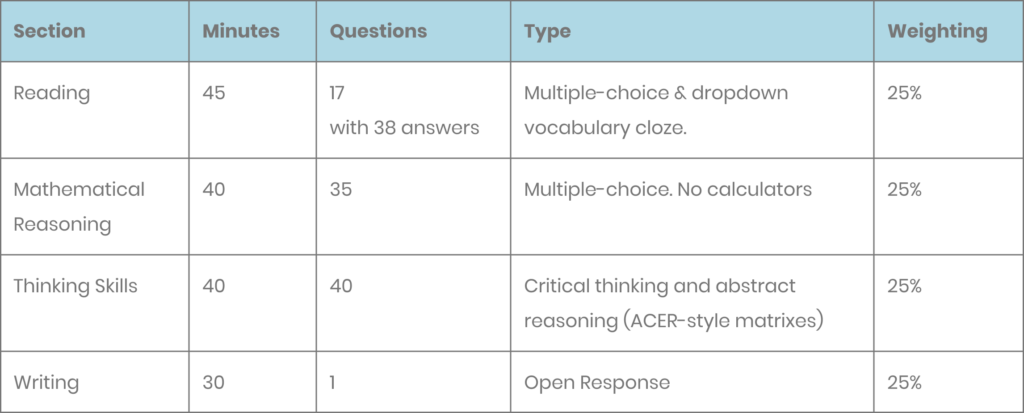
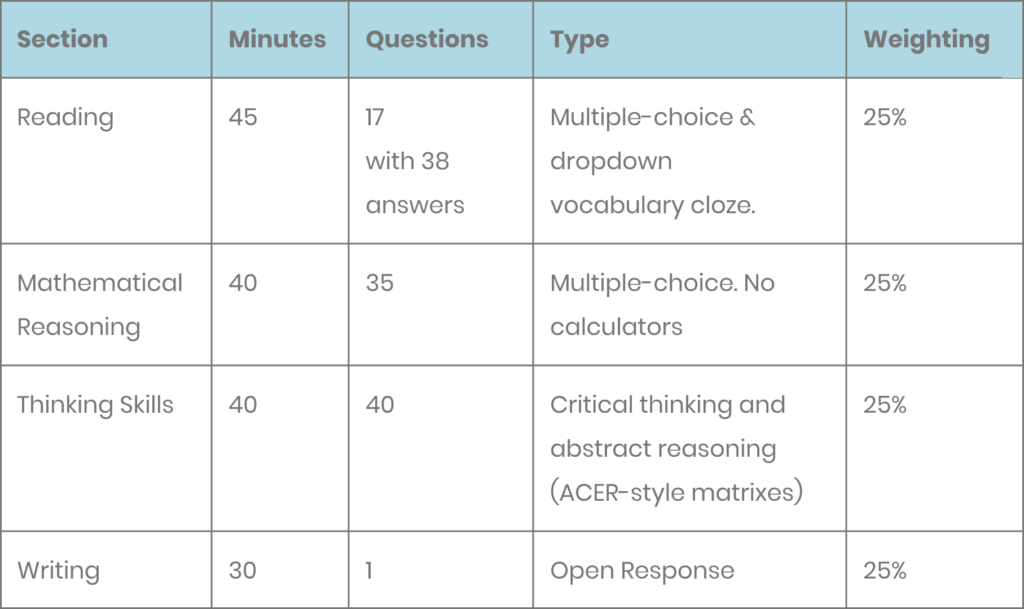
The exam now features four equally weighted sections (25% each). This is a vital change from previous years when Writing and Thinking Skills held disproportionate weightings.
| Section | Minutes | Questions | Type | Weighting |
|---|---|---|---|---|
| Reading | 45 | 17 38 answers |
multiple-choice & dropdown vocabulary cloze. |
25% |
| Mathematical Reasoning |
40 | 35 | Multiple-choice. No calculators |
25% |
| Thinking Skills | 40 | 40 | Critical thinking and abstract reasoning (ACER-style matrixes) |
25% |
| Writing | 30 | 1 | Open Response | 25% |
Tip #1: Master the Digital Environment & Practice Papers
Because the exams are now fully computer-based on the Janison platform, practicing on paper alone is no longer enough.
Get Familiar with the Digital Interface: Students must practice navigating online interfaces, using dropdown boxes (such as the new “Inline-Cloze” vocabulary sections in Reading), and typing under pressure for the Writing section.
Use Official Practice Tests: Utilise the official NSW Department of Education online practice tests to get comfortable with the digital format, flag-and-return features, and scrolling through texts on screen. You can find the official practice tests here.
Practice Under strict Timed Conditions: Managing digital test-taking stamina is a new challenge. In sections like Thinking Skills, students have less than a minute per question. Training them to flag a difficult question and move on is a critical skill.
Tip #2 Give the appropriate attention to each Section
The 2026 format focus on deeper critical analysis rather than rote memorisation.
The sections on Reading, Mathematical Reasoning and Thinking Skills are all multiple choice and are marked by a computer. The last section on Writing requires an open-ended response.
Reading (Vocabulary Cloze Updates)
The Reading sections now include complex vocabulary clozes, where students choose correct words from dropdown menus to fill blanks in a passage. Extensive, diverse reading habits are crucial to building this vocabulary.
Mathematical Reasoning (Problem-Solving over Arithmetic)
Calculators are strictly banned. While mental arithmetic is important, the test primarily measures logical mathematical deduction and multi-step problem-solving.
Thinking Skills (Abstract/Non-Verbal Focus)
This section contains a significant amount of visual, spatial, and abstract reasoning (non-verbal puzzles, pattern matrices, and logical grids). Practicing ACER-style logical puzzles is the best way to train the brain for these questions.
Writing (Typing Skill is Key)
For the Selective Test, the 30-minute writing response must be typed on a computer. Prompt-planning and basic keyboard/typing skills are highly beneficial so that writing speed does not stall a student’s creative or persuasive expression.
Tip #3 Check your work and learn from your mistakes
While practicing and getting familiar with the style of questions is really important, the biggest tip is to review and work through mistakes!
It’s okay to get questions wrong in the learning process, but they need to know why. A large portion of the tests are multiple choice, so in order to perform well, your child needs to feel confident in choosing the correct answer, rather than doing guess work.
When a student knows where they are going wrong, and can self-correct as they go, they are demonstrating that they understand the question and topics clearly, and that’s when they become more accurate in these tests.
Aim strong and true!
We strongly believe that the overall aim of education is to teach kids to love to learn! While students can feel pressure when studying and preparing for the Selective School and OC tests, it’s also a good opportunity to teach them how to work consistently and efficiently towards a goal, asking them to perform and aim that little bit higher every week, because we know they are capable. With self-belief, a positive attitude and some digital comfort they’ll be able to perform with confidence on the day.